
Last week, on the 8th and 9th of January 2026, we held a hybrid interactive hybrid workshop. Over the two days, we heard from a variety of academics and practitioners about the role of interests for learning, playing, and interacting. This blog post will tell you more about the workshop.
Thursday
Thursday began with a keynote from our own project lead Nelya Koteyko. Nelya’s keynote affirmed the importance of participatory research which takes neurodiversity and inclusion as the starting point, then shared findings from the Autism in Affinity Spaces survey (which you can read more about in our previous blog posts).
Following the keynote, Liam Cross and Gray Atherton (Plymouth) presented an overview of recent studies from the Neuroplay lab, all of which explored the role and board gaming and tabletop roleplaying in the lives of autistic people and their potential benefits for sociality and wellbeing. Next, Rita Serra (Coimbra) reflected on her lived experiences as an autistic researcher studying her personal area of focused interest (fungi) and how this interest shapes how she views the world. Rounding off the morning, Raya al Raisi (Sohar) and Zahra al Jardani (Oman College of Health Sciences) shared their research into the experiences of parents to autistic children in Oman and the difficulties finding appropriate services, particularly during the transition to adulthood.
After lunch, Elliot Wassell (Birmingham) talked about experiences of autistic joy and how supporting autistic people in accessing their focused interest helps to foster these joyful experiences. Next, Emma Pritchard-Rowe (Cambridge) continued with the theme of joy by sharing her research into autistic play. In contrast to deficit views, Emma showed us the diversity of autistic playing experiences (including solitary, social, imagined, and parallel play) and how there is no singular ‘right’ way to engage in play. Finally, Shaimma El Naggar (Fayoum) brought us back to the topic of communication by investigating discourses of ‘neurodiversity’ on TikTok and exploring how social media users create videos which challenge pathologizing narratives about autism and instead promote a strengths-based view.
We finished Thursday with a roundtable discussion, featuring Maya Albin (McMasters), Xinyun He (King’s College London), Kathryn Asbury, Kayleigh Doyle and Laura Fox (York). Together, the roundtable discussants discussed important issues such as how focused interests can form a social bridge helping autistic people to connect socially, how to integrate interests into domains such as speech therapy or educations, and what role technologies like social media or augmented reality can play in supporting autistic people.
Friday
Our second day was held in person at BLOC cinema, Queen Mary University of London, and also livestreamed online for remote attendees. To begin the day, Thea Groenhaug (Carleton) explored the role of focused interests in foreign language classrooms, showing how incorporating interests into language learning tasks could improve both enjoyment and attainment outcomes. Continuing with the theme of communication, Daniel Gill (QMUL) presented his PhD research into autistic haptic communication and human-robot interaction. Crucially, Daniel’s presentation highlighted the importance of participatory research and reflected on how the scope of his work had changed following input from the community. Next, Agnieska Sowińska and Magdalena Cyrklaff-Gorczyca (Nicolaus Copernicus) discussed their ongoing research into interest-driven and affiliative topic shifting during social interaction. Their research showed how talking about focused interests (such as video games) helped autistic students to connect socially and develop shared understanding.
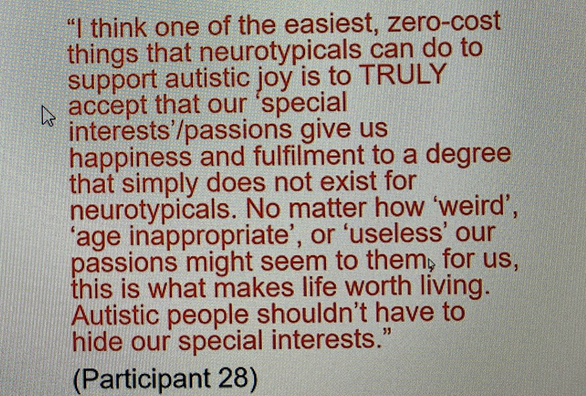
Following the presentations, it was time for our second keynote presentation. We were delighted to be joined by Pete Wharmby, neurodiversity advocate and author of ‘What I Want to Talk About.’ Pete’s talk highlighted the importance of focused interests for autistic wellbeing and communication, as not only do they provide a relief from stressful situations but also access to community and social interaction. Pete’s talk also raised insightful questions about whether focused interests enable autistic people to interact in a more authentic way and the extent to which neurotypical people are more accomodating of autistic communication styles during interest-driven conversation.
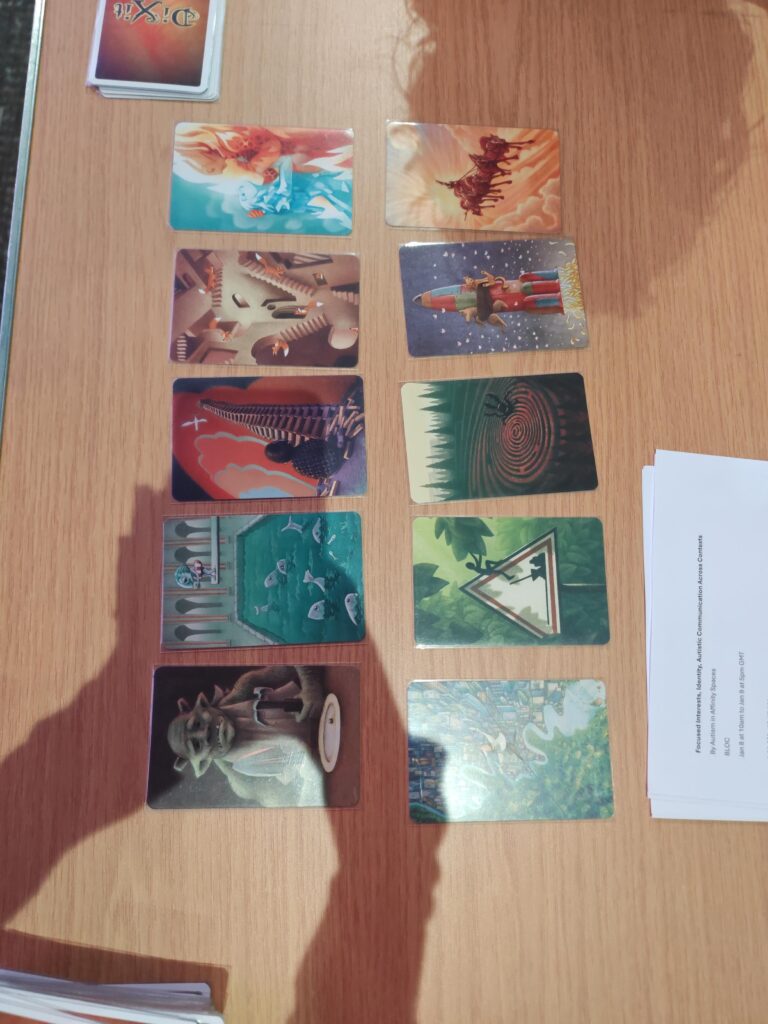
The afternoon was very gaming-focussed, as Charlie Cross, Philip Wadley, and Jago Williams (Bangor) explored autistic interaction, politeness, and decision-making in the world of tabletop roleplaying and even provided some hands-on demonstration of how to play Dungeons & Dragons. Finally, Gray Atherton and Liam Cross brought the workshop to a close through an interactive board game session. Gray and Liam first introduced us to the game of ‘Dixit’, where players select beautifully illustrated cards to represent complex concepts (which for us, included neurodivergent conditions). Following the game, we then broke out into smaller groups to brainstorm ideas for representing neurodivergent conditions in board games in an inclusive way.
Overall, the workshop was a great success. Nearly 100 people attended across the two days, bringing together expertise from lived experience, research, education, and clinical practice. We were delighted to hear more about so many fascinating research projects and the discussions have certainly given us much to think about.
If you attended, we hope you enjoyed the two days. And if not, we hope to see you at the next one!
